
Dosing Pumps Explained: Types, Selection Criteria, and Smart Dosing Systems
Dosing Pumps Explained: Types, Selection Criteria, and Smart Dosing Systems
A dosing pump, also called a metering pump, is a pump designed to deliver a precise volume of liquid into a process or system at a controlled rate. Dosing pumps are widely used in water treatment, chemical processing, electroplating, oil and gas, mining, food and beverage, semiconductor production, and new energy applications. The purpose is not merely to move fluid, but to add the right amount of chemical or nutrient at the right time with repeatable accuracy.
This guide is written for plant engineers, maintenance teams, procurement staff, and distributors who want to understand dosing pump types, key specifications, system integration options, and how to choose a reliable supplier. It also introduces the dosing pump product lines manufactured by ZHEJIANG WRS MACHINERY EQUIPMENT CO., LTD (WRS), a professional fluid-dosing equipment manufacturer based in Hangzhou, Zhejiang, China.
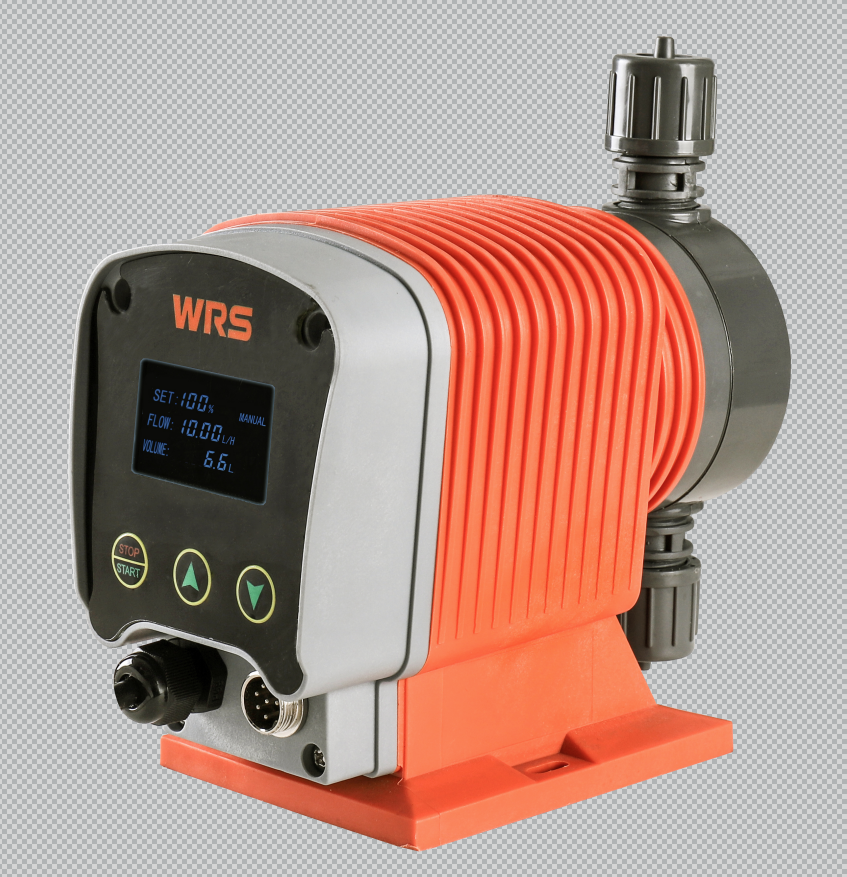
WRS dosing pump range: solenoid, digital, and mechanical diaphragm models (EML series illustrated).
What Is a Dosing Pump?
A dosing pump is a positive displacement pump that injects a measured amount of liquid, typically a chemical, additive, or nutrient solution, into a process. Unlike a standard transfer pump, a dosing pump is built for accuracy and repeatability. Key performance indicators include flow rate, discharge pressure, dosing accuracy, and compatibility with the chemical being handled.
Diaphragm dosing pumps dominate the market because they provide good accuracy with a sealed diaphragm separating the pumped liquid from the mechanical drive. According to Grand View Research, diaphragm dosing pumps led the global dosing pump market with a revenue share of 55.7% in 2024. This preference is largely because diaphragm pumps reduce the risk of leakage and handle corrosive chemicals more safely than some other designs.
WRS's main products include solenoid dosing pumps, diaphragm dosing pumps, piston dosing pumps, digital dosing pumps, hydraulic metering pumps, dosing pump check valves, pulse dampeners, chemical dosing systems, and streaming current monitoring systems.
Why Accurate Dosing Matters
Many industrial processes depend on adding a chemical in a controlled amount. Too little chemical can lead to corrosion, poor water quality, or incomplete reactions. Too much chemical can create waste, increase operating cost, or cause upsets downstream. Dosing pumps help plants manage fluids such as coagulants, pH adjusters, corrosion inhibitors, scale inhibitors, nutrients, and flocculants.
WRS's company philosophy, "Every Drop. SMART Control," reflects the shift from simple chemical feed pumps toward intelligent dosing systems with controls, sensors, and data integration.
Main Types of Dosing Pumps
Solenoid Dosing Pumps
Solenoid dosing pumps use an electromagnetic coil to drive a diaphragm at a set stroke frequency. These pumps are typically used for low-flow chemical injection in applications such as swimming pool treatment, pure water treatment, food processing, and light industrial water treatment.
The WRS model EML0020PR1C is a solenoid dosing pump with a flow rate of 1–20 L/H and a pressure range of 1–10 Bar. It offers remote control via 4–20 mA or pulse signal and Modbus RS-485 communication, a direct flow-rate display, and a double-ball check-valve design at both inlet and outlet. The dosing accuracy is stated at 1%. Available pump head materials include PVC, PVDF, and SS316. The IP65 protection rating makes it suitable for exposed or washdown environments.
Mechanical Diaphragm Dosing Pumps
Mechanical diaphragm dosing pumps use a motor-driven eccentric mechanism to flex a multilayer diaphragm. They are common in water treatment, chemical, and mining processes when flow rates are higher than solenoid pumps can handle economically.
WRS offers several mechanical diaphragm models, including:
- MA0120PQ11 – flow rate 15–500 L/H, pressure 5–10 Bar
- MG0150PQ11 – flow rate 15–150 L/H, pressure 5–10 Bar
- MB1800PQ11 – flow rate 250–1800 L/H, pressure 3–10 Bar
These models are available in PVC, PVDF, and SS316 pump head materials. Multilayer diaphragms are used to extend service life. Flow rate can be adjusted while the pump is running or idle, and motors can be equipped with frequency converter or explosion-proof options when required.
Piston Dosing Pumps
Piston dosing pumps are a robust positive displacement design for high-pressure or high-viscosity applications. The piston directly moves the liquid, which gives the pump a strong mechanical structure and the ability to pump viscous fluids. Piston pumps are used in oil and gas, hydrogen energy, power, chemical, and pharmaceutical applications.
The WRS piston pump PM060SS1PFN11 delivers 600 L/H at 8 Bar with a DN25 flange connection and a 0.75 kW motor. The larger PD105SS1PFN11 also delivers 600 L/H at 8 Bar but uses a DN50 flange and a 4.0 kW motor. Both models use SS316 as the standard wet-end material, and motor options include frequency drive and explosion-proof variants.
Hydraulic Metering Pumps
Hydraulic metering pumps use a hydraulically actuated diaphragm to achieve high pressure capability, zero internal leakage, and stable accuracy. They are suitable for toxic, hazardous, high-viscosity, or high-pressure media. These pumps are common in oil and gas, hydrogen, electric power, chemical, pharmaceutical, and new material industries.
WRS offers hydraulic pump models such as HS008S0P01S11 (2 L/H at 200 Bar, DN6 bevel-end welding tube) and HL090S0P01F11 (1600 L/H at 6 Bar, DN50 flange). Both use SS316 wetted parts and can be provided with a diaphragm rupture sensor as an option.
Digital Dosing Pumps
Digital dosing pumps integrate a motor-driven diaphragm pump with digital controls, displays, and communication interfaces. They are used in semiconductor production, food and beverage, battery production, water treatment, paper and pulp, and other new energy industries.
WRS digital pump models include:
- EMML0060FP1E – 60 L/H at 4 Bar, Rc 1/2" thread, IP65
- EMGP0200FP1C – 200 L/H at 4 Bar, Rc 1/2" thread, IP65
- EMAP1000PQ1C – 1000 L/H at 4 Bar, DN25 socket, IP65
These pumps feature a direct flow-rate display, 4–20 mA/pulse remote control, Modbus RS-485 communication, and dosing precision better than 1%. The PTFE diaphragm provides strong corrosion resistance, and the pumps can operate over a 1:1000 ratio range.
Dosing Pump Components: Check Valves and Pulse Dampeners
A dosing pump is only as accurate as its complete hydraulic circuit. Two components are especially important: the check valve and the pulse dampener.
Dosing Pump Check Valve
A check valve prevents the pumped liquid from flowing backward between strokes. In a diaphragm dosing pump, the check valve must seal reliably even with small volumes and sometimes viscous or particle-laden liquids. WRS uses a double-ball check-valve design on its solenoid pumps to improve discharge accuracy and repeatability. If a check valve leaks, the pump can lose prime and deliver inconsistent doses.
Dosing Pump Pulse Dampener
A pulse dampener smooths the pressure spikes that occur during the discharge stroke of a positive displacement pump. Dosing pumps are inherently pulsating devices, and pressure pulses can cause water hammer, inaccurate flow readings, and unstable injection into pressurized lines. A pulse dampener reduces these pulsations and improves the stability of the dosing process.
Chemical Dosing Systems and Integration
A chemical dosing system includes more than just a pump. It integrates the dosing pump with a chemical tank, injection point, piping, valves, level controls, flow meters, and often a controller or PLC. These systems are used to automate chemical feed in water treatment plants, industrial processes, electroplating lines, and livestock or agricultural operations.
WRS builds automatic dosing systems that can include remote control signals, direct flow-rate display, and communication options such as Modbus RS-485. This makes it easier for plant operators to monitor chemical consumption, adjust dose rates, and connect dosing equipment to a SCADA or building management system.
Streaming Current Monitoring System
A streaming current monitoring system is a control accessory used in water treatment to monitor the charge condition of the water and automatically adjust coagulant dosing. By continuously measuring the streaming current value, the system can help the dosing pump respond to changes in water quality. WRS includes streaming current monitoring as part of its intelligent fluid-dosing solutions.
Step-by-Step Dosing Pump Selection Process
Selecting a dosing pump requires a structured approach. The steps below are written to help buyers prepare the right information for a supplier inquiry.
Step 1: Define the Fluid and Its Properties
List the chemical name, concentration, temperature, viscosity, specific gravity, and any hazards. Fluid compatibility determines the pump head material. WRS offers PVC, PVDF, and SS316 pump head materials across most product families. For highly corrosive media, PVDF is recommended. SS316 is typically used for higher pressures, higher purity, or chemicals that are incompatible with plastics.
Step 2: Determine Maximum Flow Rate
Flow rate is the most important selection parameter for a dosing pump. The required flow rate should be compared with the maximum flow rate of the pump at the actual site pressure. Be clear about whether the stated flow rate is at zero pressure or at operating pressure.
Step 3: Determine Discharge Pressure
Pressure requirements include static pressure, line pressure, and injection-point pressure. The pump must be able to overcome the highest operating pressure while maintaining dosing accuracy. High-pressure applications may push the buyer toward hydraulic metering pumps or piston pumps.
Step 4: Choose Control Mode
Decide whether the pump will be manually adjusted, controlled by an external signal (4–20 mA or pulse), or connected to a communication network such as Modbus RS-485. Digital and solenoid WRS pumps support remote control signals, which is useful in automated systems.
Step 5: Verify Operating Environment
Consider ambient temperature, humidity, washdown exposure, and required ingress protection rating. Many WRS pumps are rated IP65. In harsh or humid environments, a higher protection class may be required.
Step 6: Consider Motor and Drive Options
Motor-driven pumps may require frequency inverters, explosion-proof motors, or special voltage configurations. WRS pump models can be supplied with frequency drive or explosion-proof motors where applicable.
Step 7: Plan Maintenance and Spare Parts
Dosing pumps require periodic maintenance of diaphragms, check valves, and seals. Buying from a manufacturer with a consistent spare parts program reduces downtime. WRS maintains a spare parts warehouse and assembly workshops, allowing faster support for repairs and replacement parts.
Step 8: Ask for a System or Package Solution
Some projects may be better served by a complete dosing package rather than a standalone pump. WRS supplies automatic systems, dosing pump accessories, and related instruments, which can reduce interface risk when several components need to work together.
Dosing Pump Applications and Use Cases
Dosing pumps serve a broad range of industries. The sections below describe common applications and where different pump types tend to fit.
Water and Wastewater Treatment
Municipal and industrial water treatment is the largest application area for metering pumps. According to Grand View Research, water and wastewater treatment held a 23.2% application share of the global metering pump market in 2025. Dosing pumps are used for coagulants, flocculants, pH adjustment chemicals, scale inhibitors, corrosion inhibitors, and disinfectants. Solenoid and digital pumps are popular in smaller treatment plants, while mechanical diaphragm and hydraulic pumps serve higher-flow or higher-pressure duties.
Electroplating and Surface Treatment
Electroplating lines require precise addition of additives, pH regulators, and metal salt solutions. Chemical dosing accuracy directly affects plating quality, bath life, and waste treatment load. WRS is active in the electroplating and surface treatment industry and supplies dosing pumps with corrosion-resistant materials.
Chemical Industry
Chemical plants use dosing pumps to inject catalysts, inhibitors, neutralizing agents, and other reagents. SS316, PVDF, and diaphragm or piston designs provide the necessary chemical compatibility. Some media are toxic or hazardous, which favors zero-leakage designs such as hydraulic diaphragm pumps.
Oil and Gas
Oil and gas applications include injecting corrosion inhibitors, scale inhibitors, demulsifiers, and methanol or hydrate inhibitors into production lines and pipelines. High-pressure injection is common, and many buyers specify explosion-proof motors. WRS lists oil and gas among its applicable industries for piston and hydraulic pumps.
Hydrogen Power Generation and New Energy
Hydrogen production and new energy systems often require precise addition of chemicals or electrolytes. WRS specifically lists hydrogen power generation as a target application for its pump range. The emphasis is on repeatable dosing, leak-free operation, and compatibility with modern control systems.
Livestock and Agricultural Dosing
In livestock farming, dosing pumps are used for nutrient solution dosing and water-line medication. One WRS application case in Russia involved a harsh, humid livestock farm environment with a 24/7 automatic dosing system that required IP67 protection. This shows how environmental requirements can be more demanding than typical indoor water treatment systems.
Dosing Pump Market Overview
The global dosing pump market was valued at approximately USD 8.86 billion in 2024, according to Grand View Research. The same source reports that Asia Pacific dominated with 41.8% of revenue share in 2024. China is a major production base for liquid pumps: OEC data indicates China's liquid pump exports, including dosing types, reached USD 14.3 billion in 2024.
Diaphragm dosing pumps held the leading product segment share in 2024 at 55.7%. Motor-driven metering pumps also dominate the broader metering pump market, with Mordor Intelligence reporting a 54.45% revenue share in 2025. Solenoid-driven dosing pumps are projected to grow at a CAGR of 5.88% through 2031.
These figures are useful for buyers who want to understand how mature the supply chain is and why standards, certifications, and factory verification matter.
Comparison: Dosing Pump Types at a Glance
| Pump Type | Typical Flow Range | Typical Pressure | Typical Materials | Best Suited For |
|---|---|---|---|---|
| Solenoid Dosing Pump | 1–20 L/H (WRS EML0020PR1C) | 1–10 Bar | PVC, PVDF, SS316 | Swimming pools, pure water, light chemical dosing, remote control applications |
| Mechanical Diaphragm Pump | 15–1800 L/H (WRS MA/MG/MB) | 3–10 Bar | PVC, PVDF, SS316 | Water treatment, chemical dosing, mining, corrosive liquids |
| Piston Dosing Pump | 600 L/H (WRS PM060/PD105) | 8 Bar | SS316 | High-viscosity liquids, oil and gas, power, chemical plants |
| Hydraulic Metering Pump | 2–1600 L/H (WRS HS/HL) | 6–200 Bar | SS316 | Toxic/hazardous media, high pressure, zero leakage applications |
| Digital Dosing Pump | 60–1000 L/H (WRS EMML/EMGP/EMAP) | 4 Bar | PVC, PVDF, SS316L | Automated plants, process control, semiconductor, food and beverage, new energy |
Standards and Compliance
Several standards can influence dosing pump selection and supplier qualification:
- API 675 is the primary international standard for positive displacement reciprocating pumps with integrated controlled capacity. Buyers in oil and gas or other demanding process industries may require API 675 compliance.
- ISO 14847:1999 specifies technical requirements for rotary positive displacement pumps, excluding safety and testing requirements.
- In the European Union, the Machinery Regulation (which will repeal Directive 2006/42/EC from 2027) mandates CE marking for metering pump units. Buyers importing into Europe should verify current CE documentation.
Buyers should ask the supplier to provide certificates, test reports, and material certifications that are relevant to their project. A supplier's own brochure or verbal claim should not be treated as complete evidence of compliance.
Supplier Evaluation Considerations
The following factors matter when evaluating dosing pump manufacturers, particularly for international buyers.
Manufacturing and Quality Control
A reliable supplier should be able to show production capacity, assembly lines, testing platforms, and quality processes. WRS operates a 15,000 m² factory with more than 120 employees, an annual output of 30,000 units, and an R&D team of 15 engineers. It maintains test platforms, a 3-dimensional coordinate measuring machine, CNC machining centers, assembly workshops, and spare parts warehouses.
Export and Local Support
Export ratio and regional service networks matter. WRS exports approximately 20% of its output to Southeast Asia, Russia, and South America. The company has local after-sales service in more than 10 countries, including Singapore, Thailand, Malaysia, Vietnam, South Korea, Japan, Russia, Chile, South Africa, Angola, and Turkey.
Product Range and Customization
A broad product range is useful because a single project may require pumps of different sizes, materials, and control modes. WRS covers flow rates from 1 L/H to 1800 L/H across solenoid, mechanical diaphragm, piston, hydraulic, and digital pump families, plus accessories and complete system solutions.
Market Context: Competitors
According to Mordor Intelligence, the top global competitors in the dosing system market include Grundfos, IDEX (Milton Roy), ProMinent, and SEKO S.p.A. Buyers should compare manufacturers on specifications, pricing, lead time, certification, after-sales support, and documented application experience.
How WRS Positions Its Dosing Pump Line
WRS is a China-based manufacturing company that sells globally through a combination of direct export and local representation. The company's products are used in water treatment, electroplating and surface treatment, chemical industry, oil and gas, hydrogen power generation, paper and pulp production, semiconductor production, mining, and livestock farming.
WRS states its mission as providing intelligent solutions for fluid dosing, with product coverage across dosing pumps, instruments and meters, accessories, automatic PAC dry powder systems, and dosing devices. Its logo tagline, "Every Drop. SMART Control," is intended to describe the company's focus on precision and intelligent dosing rather than simply pumping liquid from one point to another.
In practice, WRS supports projects at several levels: individual dosing pumps, fully automatic dosing systems, monitoring instruments such as streaming current monitoring, and auxiliary components such as check valves and pulse dampeners.
Common Dosing Pump Problems and How to Avoid Them
Unstable or Dropping Flow Rate
If discharge flow rate drops or becomes unstable, the most common cause is a blocked inlet or outlet. The correct response is to check the strainer, tubing, and valves, then clean or replace them if necessary. This troubleshooting guidance is consistent with standard dosing pump practice: suction-side blockages are a leading cause of inconsistent dosing.
Incorrect Material Selection
Using the wrong pump head material can cause rapid corrosion, contamination, or failure. For highly corrosive media, PVDF is recommended. If a chemical is not compatible with PVC, buyers should move up to PVDF or SS316 depending on pressure, temperature, and purity requirements.
Missing or Improper Accessories
A dosing pump without a foot valve, injection valve, safety valve, or pulse dampener may perform poorly in certain installations. WRS solenoid pumps can be supplied with accessories including PE tube, foot valve, weight, injection valve, and safety valve.
Poor Communication With Plant Control Systems
If a pump cannot receive a 4–20 mA signal or communicate over Modbus, it may be difficult to integrate into an automated process. Buyers who plan to use SCADA or PLC control should verify the pump's control mode before purchase.
Recommended Budgeting and Procurement Approach
Rather than selecting a pump based on catalog price alone, buyers should evaluate total ownership factors:
- Chemical compatibility and expected service life of wetted parts.
- Dosing accuracy and how it affects chemical consumption.
- Ease of calibration, maintenance, and spare parts availability.
- Control features and integration effort.
- Supplier lead times, packaging, freight, and technical support.
- Certification and documentation needed for local regulatory acceptance.
For a distributor, additional factors include minimum order quantities, warranty terms, training materials, marketing support, and after-sales responsiveness.
Sample Inquiry Checklist
When sending a dosing pump inquiry to WRS or any manufacturer, include the following information:
- Fluid name, concentration, and temperature.
- Required flow rate in L/H.
- Maximum discharge pressure in Bar.
- Connection type and size (flange, threaded, socket).
- Pump head material preference: PVC, PVDF, or SS316.
- Voltage and frequency.
- Required control mode: manual, 4–20 mA, pulse, or Modbus RS-485.
- Environment: indoor, outdoor, washdown, hazardous area, IP rating.
- Any requirement for explosion-proof or frequency-converter motors.
- Accessories needed: check valve, pulse dampener, tank, panel, or system package.
FAQ
What is the difference between a dosing pump and a metering pump?
A dosing pump and a metering pump are the same class of equipment. Both terms describe a pump that delivers a controlled volume of liquid at a controlled rate. In practice, "metering pump" is often used for higher-pressure, high-accuracy industrial pumps, while "dosing pump" is a broader term used in water treatment, chemical feed, and process dosing applications. Buyers should focus on specifications like flow rate, pressure, materials, and accuracy rather than the label.
How do I choose between a solenoid, mechanical diaphragm, piston, and hydraulic dosing pump?
Choose based on flow rate, pressure, fluid properties, and control needs. Solenoid pumps suit low flow rates around 1–20 L/H and pressures up to 10 Bar. Mechanical diaphragm pumps handle higher flows, typically from 15 L/H up to 1800 L/H, at pressures from 3 to 10 Bar. Piston pumps are chosen for high-viscosity or demanding industrial service. Hydraulic pumps are used for high-pressure, zero-leakage, or hazardous chemical applications. WRS offers all four types, allowing comparison of models such as EML0020PR1C, MB1800PQ11, PM060SS1PFN11, and HL090S0P01F11.
What pump head material should I select for strong corrosive liquids?
For highly corrosive media, PVDF is recommended. Different chemicals require different material compatibility. WRS pump families are available in PVC, PVDF, and SS316, so the final choice should be based on the specific chemical, temperature, and pressure conditions of the application.
What control options should I look for in a digital dosing pump?
Typical control options include manual adjustment, external 4–20 mA signal, pulse signal, and digital communication such as Modbus RS-485. WRS digital dosing pumps such as the EMML0060FP1E and EMGP0200FP1C support these control modes and show a direct flow-rate display. This makes them suitable for automated treatment systems and remote monitoring.
What are typical lead times and how can I start an inquiry?
Lead times depend on model, material, motor configuration, and order volume. To get accurate information, it is best to send a complete inquiry with the product specifications listed above. You can contact WRS by email at isak@wrsindustry.com or by phone/WhatsApp at +86-173 0642 4430. A company brochure with additional product details is available for download.
For a specific quote or engineering inquiry, contact isak@wrsindustry.com.
WRS official website: www.wrsdosing.com
Conclusion
Dosing pumps are essential for any process that requires controlled chemical injection. The main decision areas are pump technology, flow rate, pressure, wetted materials, control mode, and supporting components such as check valves and pulse dampeners. Buyers at the awareness and research stage should use this framework to understand what a dosing pump must deliver before comparing suppliers.
WRS is one example of a manufacturer that covers this range with solenoid, mechanical diaphragm, piston, hydraulic, and digital dosing pump models, plus accessories, monitoring instruments, and complete systems. A reliable supplier should be able to document its factory, testing processes, export experience, and after-sales service network.
Have Questions or Need More Details?
Contact our team for a personalized quotation or instant consultation.
Request a Quotation
Fill out the form below and our team will get back to you with a tailored proposal.
WhatsApp Direct Chat
Prefer to chat in real-time? Message us on WhatsApp for instant assistance & quick answers.
- Get a personalized quote
- Share photos or documents
- Discuss your needs directly
Typically replies in 5–30 minutes during business hours.