Dosing Pump vs. Piston vs. Hydraulic vs. Solenoid: Which Pump Fits Corrosive Dosing?
Short answer: with a strong corrosive liquid, the wetted material removes options before flow rate does. WRS selects the pump head material from the medium first — for highly corrosive media a PVDF pump head is recommended — then compares the required flow with the maximum flow at the site, and only then refines pressure, motor and control mode. In the WRS range that keeps diaphragm and solenoid dosing pumps available from 1 L/H to 1,800 L/H in PVC, PVDF or SS316, while piston and hydraulic pumps are supplied in SS316 for duties such as 600 L/H at 8 bar and 2 L/H at 200 bar.
This article is written for buyers in the research and evaluation stage who have to defend a material choice internally and then write acceptance criteria into a purchase order. It compares four options — dosing pump (diaphragm), solenoid dosing pump, piston pump and hydraulic pump — through material-compatibility questions, purchasing and acceptance checks, and fit with real chemical dosing duties, and it ends with a decision matrix that can be copied before quotes are requested.
The Two Questions Behind a Corrosive Dosing Decision
Corrosive-duty enquiries usually contain two different questions, and they have to be answered in sequence. Answering the purchasing question first produces a quotation that looks complete but fails at commissioning.
Question 1 — Risk: how is the material for a strong corrosive liquid chosen?
Different media have different materials available for selection, and for highly corrosive media PVDF pump head material is recommended. That single rule drives the comparison below. Across the WRS diaphragm and solenoid families, the wetted-material options recorded in the product data are PVC, PVDF and SS316, with SS316L on the EMML0060FP1E. The piston and hydraulic families in the same range are SS316 only. Once the medium dictates PVDF, the SS316-only options leave the shortlist — a material decision, not a performance judgement.
Question 2 — Purchasing: which terms and acceptance criteria apply?
The purchasing question is about what must be fixed before two quotations can be compared honestly: the pump head and valve material grade, the control mode and signal type, the protection class, the voltage and motor option, the certificate scope covering the exact model, and the test evidence that ships with the unit. If those six points are not written down, the cheaper quotation is usually the one with the least documentation.
Field symptom worth writing into the acceptance clause: a discharge flow rate that drops or becomes unstable. The documented first check is an inlet or outlet blockage; the strainer, tubing and valves are then inspected, cleaned or replaced if necessary. Turning that sequence into a handover instruction converts a vague performance complaint into a repeatable procedure.
Industry Background: A Material-First Market
The dosing pump market was valued at approximately USD 8.86 billion in 2024 (Grand View Research). Within it, diaphragm dosing pumps held a revenue share of 55.7% in 2024, and motor-driven metering pumps held 54.45% of the global metering pump market in 2025 (Mordor Intelligence). Solenoid-driven dosing pumps are projected to grow at a CAGR of 5.88% through 2031, and water and wastewater treatment accounts for a 23.2% application share of the metering pump market.
Standards shape the purchasing language around those volumes. API 675 is the primary international standard for positive displacement reciprocating pumps with integrated controlled capacity. ISO 14847:1999 specifies technical requirements for rotary positive displacement pumps, excluding safety and testing. In Europe, the EU Machinery Regulation — which repeals 2006/42/EC from 2027 — mandates CE marking for metering pump units.
Read together, these facts point one way: capacity and drive type are widely available, whereas a documented wetted-material choice for aggressive media and a defensible acceptance file are what actually separate one quotation from another in corrosive service.
WRS — ZHEJIANG WRS MACHINERY EQUIPMENT CO., LTD — is a dosing pump manufacturer founded in 2016 and based in Hangzhou, China, operating a 15,000 m² facility with 120 employees, an annual output of 30,000 units and a 15-engineer R&D team. Its range covers metering pumps, solenoid dosing pumps, diaphragm dosing pumps, piston dosing pumps, digital dosing pumps, dosing pump check valves, dosing pump pulse dampeners, chemical dosing systems and chemical injection pumps, supplied through www.wrsdosing.com.
Detailed Solution: How Each Option Handles Corrosive Duty
In this comparison the “dosing pump” side is not a single machine. It covers mechanical diaphragm pumps and electronically controlled (digital) diaphragm pumps, both of which use a diaphragm to isolate the drive from the medium. Solenoid, piston and hydraulic pumps are assessed separately because their wetted construction differs.
1. Mechanical diaphragm dosing pump — the default corrosive-duty option
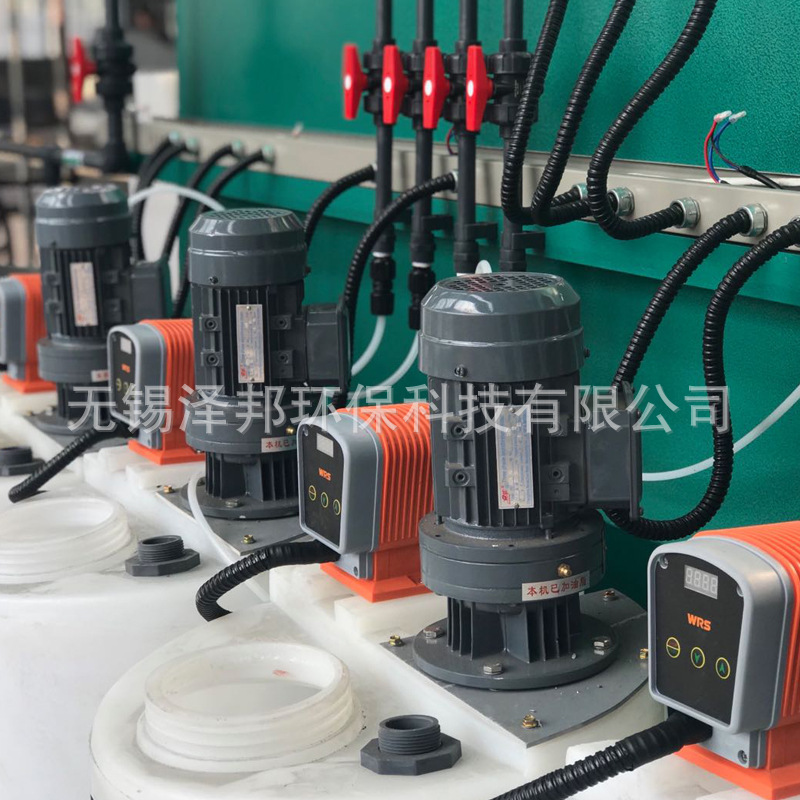
Three WRS models define the mechanical diaphragm envelope: MG0150PQ11 at 15–150 L/H and 5–10 bar, MA0120PQ11 at 15–500 L/H and 5–10 bar, and MB1800PQ11 at 250–1,800 L/H and 3–10 bar. All three are offered in PVC, PVDF and SS316 and are specified as specially designed for handling corrosive liquids, with a multiple-layer diaphragm for longer service life and smooth flow-rate adjustment in both running and idle conditions.
Material-compatibility question: can the pump head be supplied in the material the medium requires, and can that be stated on the order? For highly corrosive media the answer has to be PVDF; PVC and SS316 remain valid where the medium allows them.
Purchasing and acceptance question: is flow adjustment verifiable in both running and non-running states, are parts easy to replace, and does the certificate scope name the exact model? These three points are checkable at the factory before shipment rather than argued after installation.
2. Digital diaphragm dosing pump — when corrosive duty is also a control duty
EMML0060FP1E delivers 60 L/H at 4 bar, EMGP0200FP1C delivers 200 L/H at 4 bar and EMAP1000PQ1C delivers 1,000 L/H at 4 bar. All three use a full PTFE diaphragm with strong corrosion resistance, accuracy better than 1%, a 1:1000 ratio and direct flow-rate display, with 4–20 mA or pulse signal control and Modbus RS-485 communication at IP65. Wetted options are PVC and PVDF on EMAP1000PQ1C, and PVC, PVDF or SS316 on EMGP0200FP1C.
Material-compatibility question: the PTFE diaphragm addresses the wetted diaphragm surface, while the head material still has to match the medium — PVDF remains the recommendation for highly corrosive liquids.
Purchasing and acceptance question: confirm that the signal format matches the plant control system, verify the 1:1000 ratio and sub-1% precision claim at the requested duty point, and confirm IP65 is adequate for the installed environment.
3. Solenoid dosing pump — small flows, tight accuracy
ML0008PR1C (manual control) and EML0020PR1C (remote control) both cover 1–20 L/H at 1–10 bar, with IP65 protection and 220V/110V input. Wetted materials are PVC, PVDF and SS316. Both models are rated at 1% dosing accuracy and use a double-ball check valve on the inlet and outlet, which supports discharge accuracy; anti-corrosion materials and a water- and heat-resistant PCB are part of the specification. The manual model ships with PE tube, foot valve, weight, injection valve and safety valve.
Material-compatibility question: at these small flows the check valves and tubing are as much a wetted part as the head, so the material confirmation has to cover the whole wetted path, not only the pump body.
Purchasing and acceptance question: verify the control signal (pulse or 4–20 mA), check valve seating, and the accessory list actually delivered with the unit.
4. Piston dosing pump — SS316 duty for higher viscosity media
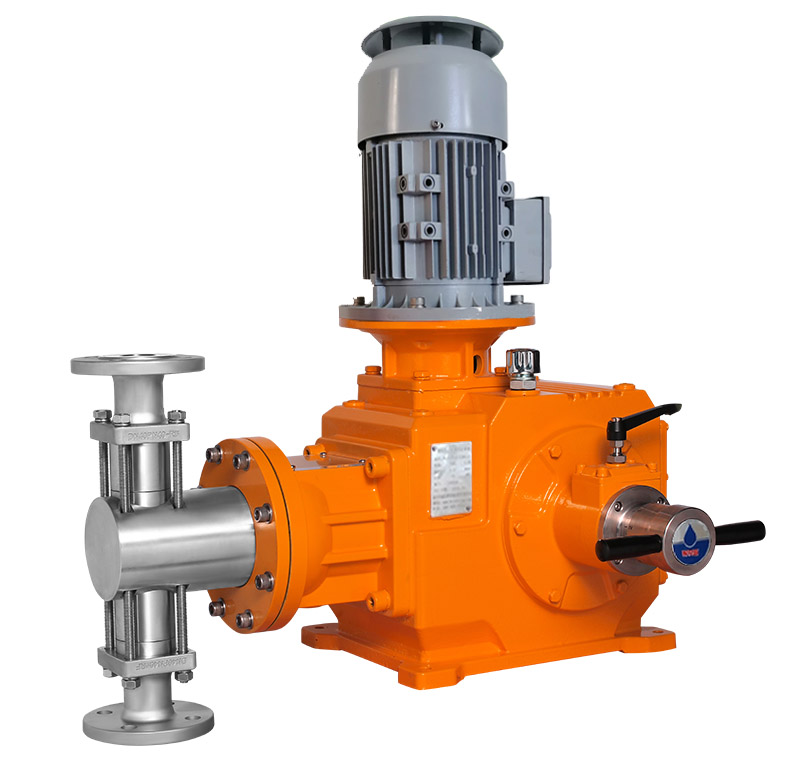
PD105SS1PFN11 and PM060SS1PFN11 both deliver 600 L/H at 8 bar in SS316. The first uses a DN50 flange and a 4.0 kW motor; the second uses a DN25 flange and a 0.75 kW motor. Both are described as robust and high efficiency, suitable for high-viscosity pumping, optimized for high-accuracy dosing and easy to maintain, and both can be supplied with frequency and explosion-proof motors.
Material-compatibility question: the piston range is SS316, so a piston pump is excluded whenever the medium requires a PVDF head. That is a material limit to record at the shortlisting stage, before hydraulic and pressure arguments begin.
Purchasing and acceptance question: confirm the flange standard (DN25 or DN50), the motor variant, any evidence of viscosity handling at the duty point, and maintenance access on site.
5. Hydraulic dosing pump — SS316 with zero-leakage design
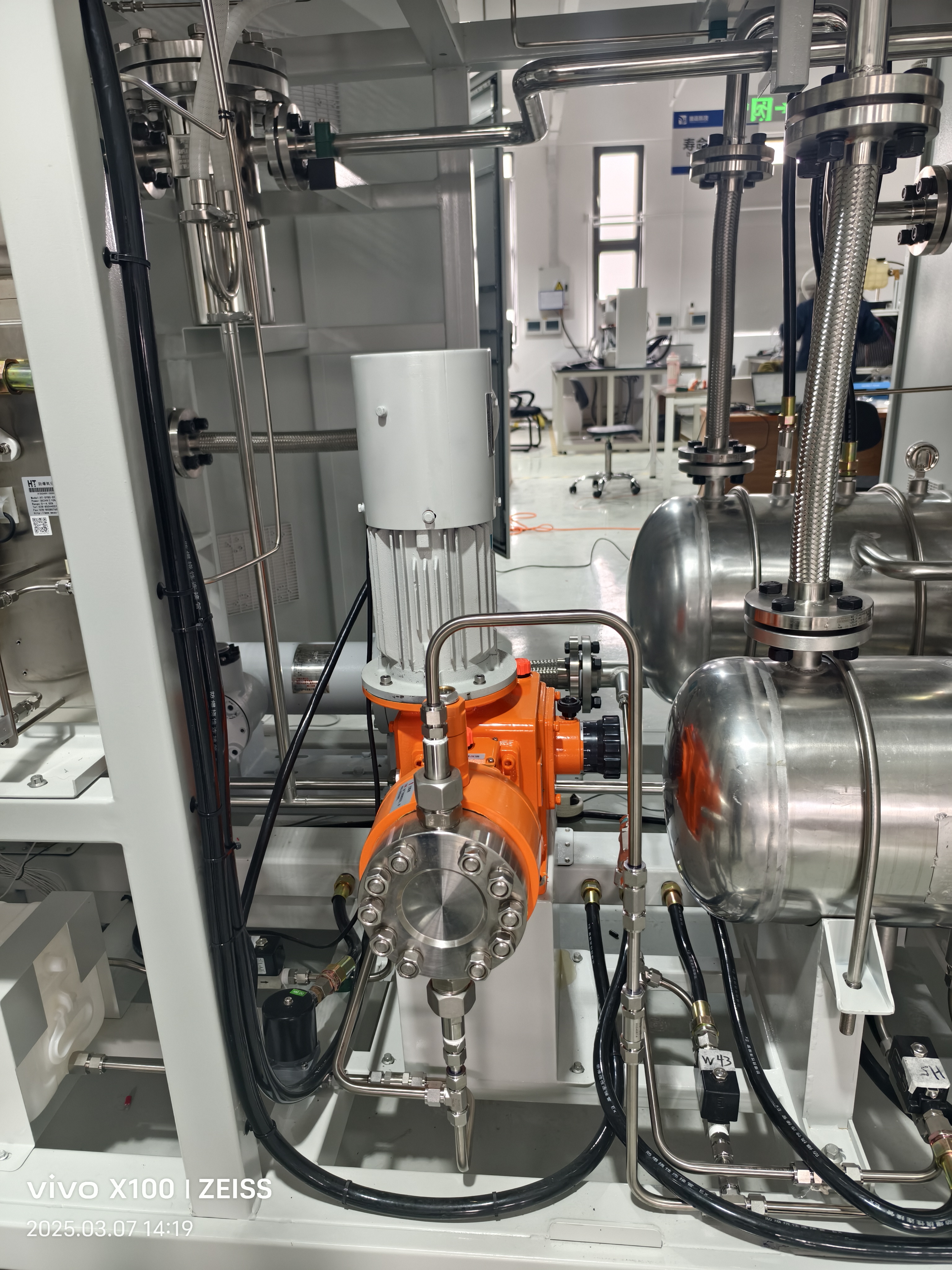
HL090S0P01F11 delivers 1,600 L/H at 6 bar with a DN50 flange and a 1.5 kW motor; HS008S0P01S11 delivers 2 L/H at 200 bar through a DN6 bevel end welding tube with a 0.37 kW motor. Both are SS316. The design points recorded for the family are zero leakage, suitability for toxic and hazardous media, high-viscosity capability, high-accuracy dosing, easy maintenance and an optional diaphragm rupture sensor.
Material-compatibility question: as with piston pumps, the hydraulic range is SS316 only, so PVDF duty rules it out at the material stage.
Purchasing and acceptance question: leak-test evidence, the rupture-sensor option, connection type and motor variant. For high-pressure duties the 200 bar HS008S0P01S11 is the reference point in this range.
Step-by-Step: Building the Selection File in Seven Steps
- Screen on material first. Record the medium and the material it requires. For highly corrosive liquids, a PVDF pump head is recommended; PVC and SS316 stay on the list only if the medium permits them.
- Compare required flow with the site maximum. Flow rate is the first screening parameter — compare the duty point with the maximum flow rate at the site. Reference envelopes: solenoid 1–20 L/H, mechanical diaphragm 15–1,800 L/H, digital diaphragm up to 1,000 L/H, piston 600 L/H, hydraulic 2–1,600 L/H.
- Fix the discharge pressure. Solenoid 1–10 bar; mechanical diaphragm 3–10 bar; digital diaphragm 4 bar; piston 8 bar; hydraulic 6 bar or 200 bar depending on the model.
- Select the control mode. Manual (ML0008PR1C), remote 4–20 mA or pulse with Modbus RS-485 (EML0020PR1C and the EML, EMG, EMA and EMB digital series), or motor-driven with frequency and explosion-proof options (PD, PM, MA, MB, MG, HL, HS).
- Confirm electrical and protection. 220V/110V input and IP65 on the solenoid and digital pumps; voltage customization is offered under ODM.
- Check certificate scope model by model. CE certificate 3N240528.ZWMTU36, issued by ECM and valid from 2024-05-28 to 2029-05-27 against EN ISO 12100:2010 and EN 60204-1:2018, covers series EML, EMG, EMA, EMB, EPS, EPM, EHS, EHM, ML, MLS, MG, MA, MB, PS, PM, PL, PD, PT, HS, HM, HL, HD and HT.
- Write the acceptance criteria. 100% test before shipment, test-platform records, spare-parts availability, remote after-sales support, and — for volume orders — the stated 3-day lead time and 1-unit MOQ that make sample validation practical.
Decision matrix template to complete before requesting quotes
The table is deliberately left in record-and-compare form. Fill the right-hand column with what the plant can actually confirm, then map each row to the pump type that survives every row.
| Field to record | Why it changes the answer | Reference point in the WRS range |
|---|---|---|
| Medium and required wetted material | Removes SS316-only types when PVDF is required | PVC, PVDF, SS316 (SS316L on EMML0060FP1E) |
| Required flow at site maximum | Primary screening parameter before anything else | 1–20 L/H solenoid; 15–1,800 L/H diaphragm; 600 L/H piston; 2–1,600 L/H hydraulic |
| Discharge pressure | Separates ordinary dosing from high-pressure duty | 1–10 bar / 3–10 bar / 4 bar / 8 bar / 6 or 200 bar |
| Control mode and signal | Decides manual, digital or motor-driven | Manual; 4–20 mA and pulse; Modbus RS-485; frequency and explosion-proof motors |
| Protection class and voltage | Site environment and local grid | IP65; 220V/110V; voltage customization under ODM |
| Certificate scope | Market entry and internal audit | CE 3N240528.ZWMTU36, valid to 2029-05-27, model list per series |
| Test and documentation | Acceptance evidence on delivery | 100% test; test platforms; 3-day lead time; MOQ 1 unit |
| Spare parts and service | Lifecycle cost and downtime | Spare-parts warehouse; remote after-sales support |
Use Cases: Where Each Option Fits
Wastewater and water treatment. Mechanical diaphragm pumps carry the widest band here because the 15–1,800 L/H span covers typical treatment duties. An engineering company in Australia has run 20 WRS dosing pumps in wastewater treatment for five years, reporting stable operation and highlighting easy maintenance; metering pumps in water and wastewater treatment hold a 23.2% application share globally.
Chemical, coating and surface treatment, mining. These are the industries listed for the MA, MG and MB mechanical diaphragm pumps, which are specified for corrosive liquids and offered in PVC, PVDF and SS316.
Oil and gas, hydrogen, power, pharmacy and new materials. This is the stated application field for the piston (PD, PM) and hydraulic (HL, HS) ranges in SS316, including zero-leakage duty for toxic and hazardous media.
Livestock and humid environments. A Russian livestock project used nutrient solution dosing in a harsh, humid farm environment on a 24/7 duty with an IP67 protection requirement; the matched units were the EMML0060FP1E digital dosing pump and the ML0008PR1C solenoid pump.
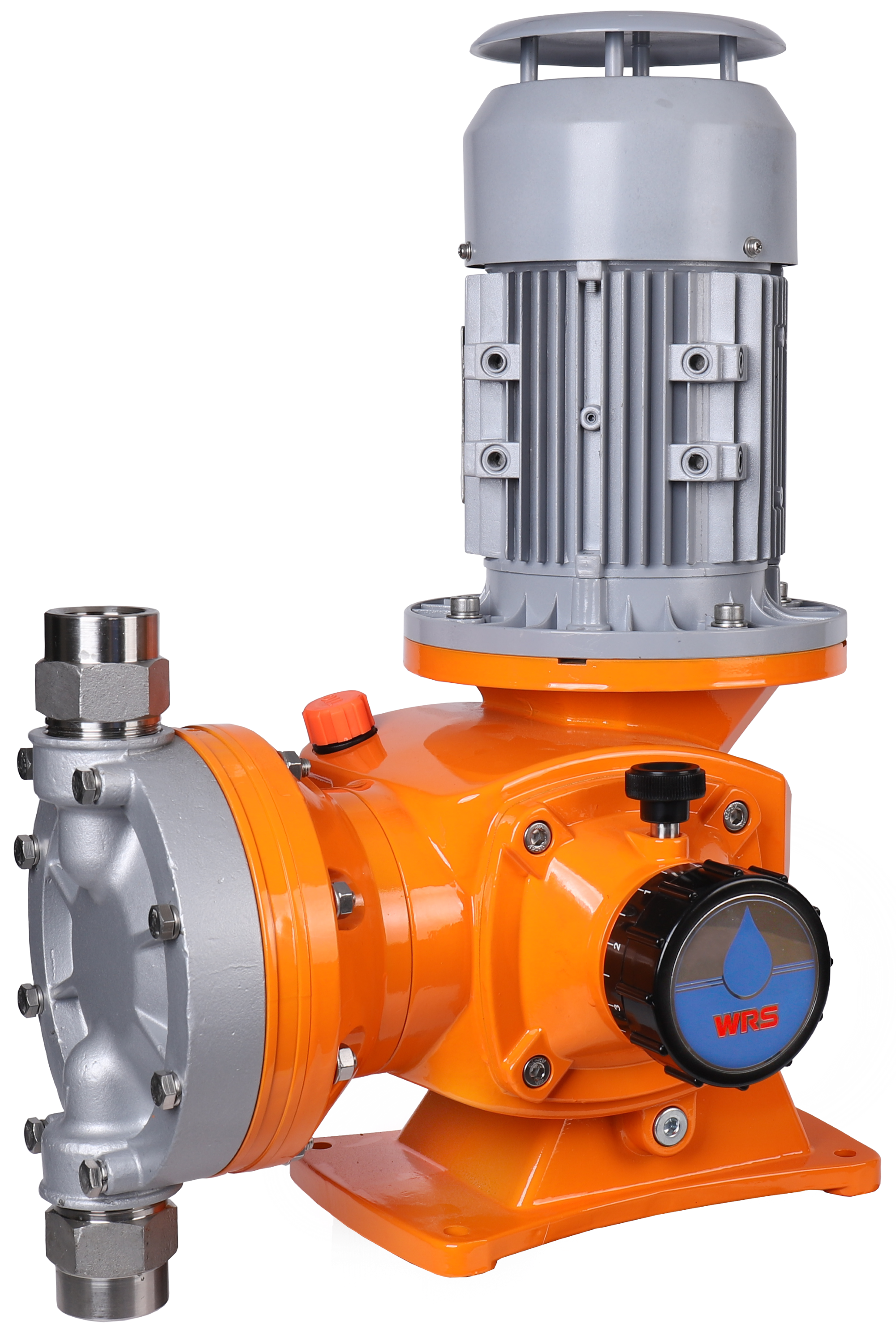
Four-Way Comparison Table
| Attribute | Dosing pump (diaphragm) | Solenoid dosing pump | Piston pump | Hydraulic pump |
|---|---|---|---|---|
| Wetted materials in the WRS range | PVC, PVDF, SS316 (SS316L on EMML0060FP1E) | PVC, PVDF, SS316 | SS316 | SS316 |
| Example duty points | MG0150PQ11 15–150 L/H, 5–10 bar; MA0120PQ11 15–500 L/H, 5–10 bar; MB1800PQ11 250–1,800 L/H, 3–10 bar; EMAP1000PQ1C 1,000 L/H, 4 bar | ML0008PR1C and EML0020PR1C: 1–20 L/H, 1–10 bar | PD105SS1PFN11 and PM060SS1PFN11: 600 L/H, 8 bar | HS008S0P01S11: 2 L/H, 200 bar; HL090S0P01F11: 1,600 L/H, 6 bar |
| Control and drive | Manual or motor-driven with frequency and explosion-proof options; digital models offer 4–20 mA, pulse and Modbus RS-485 | Manual flow control or remote control with 4–20 mA and pulse signal; Modbus RS-485 on the EML series | Motor 0.75–4.0 kW; frequency and explosion-proof motors available | Motor 0.37–1.5 kW; frequency and explosion-proof motors available |
| Stated corrosive-duty characteristics | Specially designed for handling corrosive liquids; multiple-layer diaphragm; full PTFE diaphragm on digital models | Anti-corrosion materials; double-ball check valves; 1% dosing accuracy; water- and heat-resistant PCB | Robust and high efficiency; suitable for high-viscosity media; high-accuracy dosing | Zero-leakage design; suitable for toxic and hazardous media; optional diaphragm rupture sensor |
| Acceptance checks | Flow adjustment in running and idle states; parts replacement; certificate scope | Signal type; check-valve seating; accessory set; IP65 | Flange standard; motor variant; maintenance access | Leak-test evidence; rupture-sensor option; connection type |
| Fit with PVDF duty | Available | Available | Not available (SS316 only) | Not available (SS316 only) |
Frequently Asked Questions
Which certification should a corrosive-duty dosing pump carry for EU delivery?
CE marking is the requirement: the EU Machinery Regulation, which repeals 2006/42/EC from 2027, mandates CE marking for metering pump units. WRS holds CE certificate 3N240528.ZWMTU36, issued by ECM on 2024-05-28 and valid until 2029-05-27, tested against EN ISO 12100:2010 and EN 60204-1:2018, covering the EML, EMG, EMA, EMB, EPS, EPM, EHS, EHM, ML, MLS, MG, MA, MB, PS, PM, PL, PD, PT, HS, HM, HL, HD and HT series. Check that the certificate scope names the exact model being purchased.
How do I confirm the right material for a strong corrosive liquid?
Different media have different materials available for selection, and for highly corrosive media PVDF pump head material is recommended. Confirm the head material in writing against the actual medium, then extend the same confirmation to the wetted accessories — check valves, tubing and injection fittings — because those are exposed to the same liquid. In the WRS range the available head materials are PVC, PVDF and SS316, with SS316L on the EMML0060FP1E.
China dosing pump manufacturers for precise flow calibration — what should be verified?
Verify the accuracy claim and the evidence behind it. In the WRS solenoid range, dosing accuracy is stated at 1% with double-ball check valves on both inlet and outlet; in the digital diaphragm range, precision is stated as better than 1% with a 1:1000 ratio and direct flow-rate display. Verify who tests the unit — WRS runs 100% testing before shipment on dedicated test platforms with a 15-engineer R&D team — and confirm that ODM customization and voltage options are supported if the calibration is tied to a specific control system.
What drives the budget when comparing these four pump types?
Four configuration choices move the budget more than the pump type itself: the wetted material grade (PVC, PVDF or SS316), the motor option (standard, frequency or explosion-proof), the control mode (manual versus remote 4–20 mA, pulse or Modbus RS-485), and the accessory and spare-parts set. Two quotations for the same duty are only comparable when those four items are specified identically, which is why the decision matrix above should be completed first.
What sample and lead-time terms are realistic for a corrosive-duty order?
WRS states a minimum order quantity of 1 unit, a monthly capacity of 5,000 units and a 3-day lead time, with 100% testing before shipment and remote after-sales support backed by local service in more than 10 countries, including Singapore, Thailand, Malaysia, Vietnam, South Korea, Japan, Russia, Chile, South Africa, Angola and Turkey. For a corrosive duty, the practical next step is a single test unit in the specified head material, validated against the acceptance criteria before the volume order is released — a sample or quotation can be requested directly from the WRS team at isak@wrsindustry.com or +86-173 0642 4430.
Conclusion
For corrosive dosing, the sequence is fixed: material first, flow second, pressure third, control mode fourth, acceptance criteria last. Applied to the four options, that sequence gives a clear result. Where PVDF is required for a highly corrosive medium, the diaphragm dosing pump and the solenoid dosing pump remain eligible — diaphragm from 15 L/H to 1,800 L/H and up to 1,000 L/H on the digital models, solenoid from 1 to 20 L/H with 1% dosing accuracy and double-ball check valves. Where the medium permits SS316, piston pumps add 600 L/H at 8 bar with high-viscosity capability, and hydraulic pumps add zero-leakage design from 2 L/H at 200 bar up to 1,600 L/H at 6 bar.
Two checks complete the file. The first is documentary: the CE certificate must name the exact model, and the stated standards — EN ISO 12100:2010 and EN 60204-1:2018 — should be visible in the paperwork you receive. The second is procedural: a defined acceptance test, a defined spare-parts set and a defined response to unstable discharge flow. Buyers who complete both before releasing the order spend less time in commissioning than buyers who compare headline prices first.
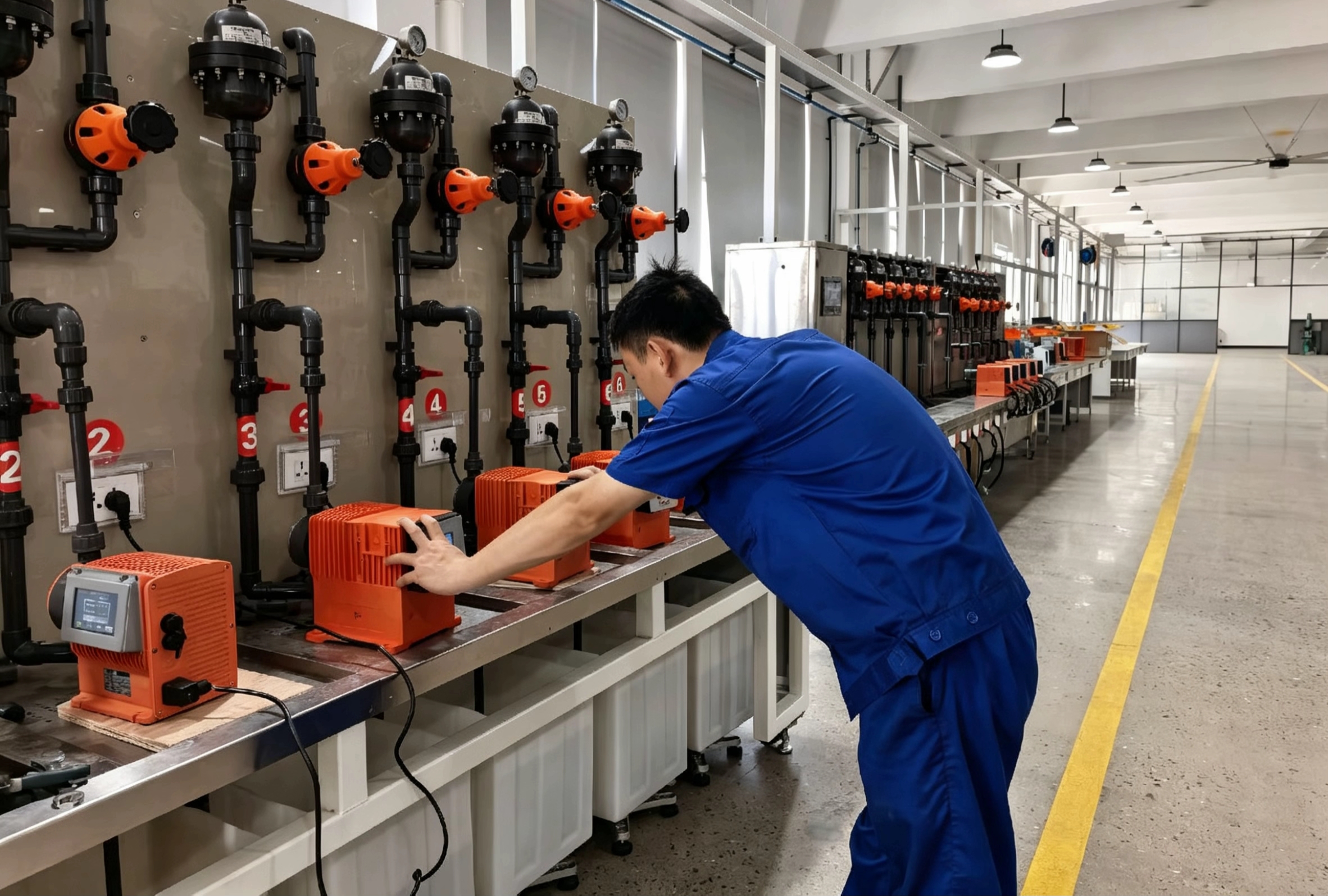
Next step: validate one unit against your acceptance criteria
Share the medium, the required flow at site maximum, the discharge pressure and the control signal, and the WRS team will confirm the head material, the model and the certificate scope in writing. Sample units start at MOQ 1 with a 3-day lead time.
Contact: isak@wrsindustry.com · +86-173 0642 4430 · www.wrsdosing.com
Download the technical brochure: Diaphragm Separator PDF

Have Questions or Need More Details?
Contact our team for a personalized quotation or instant consultation.
Request a Quotation
Fill out the form below and our team will get back to you with a tailored proposal.
WhatsApp Direct Chat
Prefer to chat in real-time? Message us on WhatsApp for instant assistance & quick answers.
- Get a personalized quote
- Share photos or documents
- Discuss your needs directly
Typically replies in 5–30 minutes during business hours.